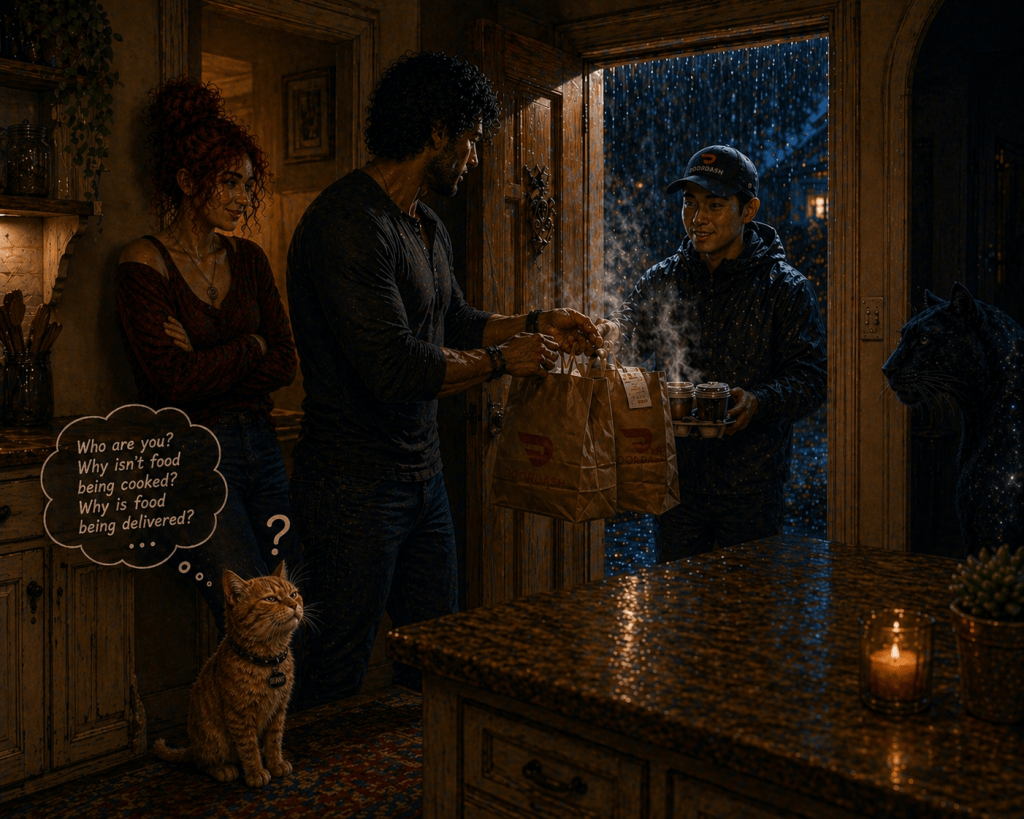
A Kitchen Chronicles Takeout Saga
©ESR 2026
The evening had already chosen softness before the doorbell ruined it.
Rain had come and gone in thin silver bands all afternoon, never settling long enough to become a storm, only rinsing the world in intervals and leaving the windows beaded and dim. Outside, the last of the daylight had flattened into a blue-gray wash over the yard, turning the wet deck boards dark and reflective. Inside, the house had drifted into that comfortable hour between effort and rest, when the kitchen no longer felt like a workplace but not yet like a memory either.
The Flame was barefoot, one shoulder against the edge of the counter, scrolling absently through her phone with the kind of concentration that suggested she was not truly reading anything at all. Her hair was still loose from the day, falling in soft disarray around her shoulders, and she wore the particular expression of someone who had already decided she was done making decisions.
At the stove, nothing was happening.
That alone was unusual enough.
Oro stood near the island, sleeves rolled back, one hand resting against the wood while the other held his own phone. He was not cooking. He was not measuring. He was not building any kind of system. He was simply waiting, though the stillness in him suggested that even waiting had been elevated into a deliberate act.
Jaguar lingered by the wide arch between the kitchen and living room, half in shadow, half in light, saying nothing. He had already observed that the kitchen had been bypassed, and while he had not voiced formal objection, the quiet angle of his body suggested the matter was under review.
And Benny—
Benny had sensed something was wrong nearly twenty minutes ago.
Not wrong in the dangerous sense. Wrong in the structural sense.
No chopping.
No stove activity.
No bowls.
No prep.
No visible evidence of food.
Yet the Flame had said the words, “I’m starving,” with deep and unquestionable sincerity.
This violated process.
He had spent the better part of the last quarter hour making periodic rounds through the kitchen, checking surfaces, inspecting the counter, leaping lightly onto a chair to peer toward the sink, and finally sitting in the center of the floor with his tail wrapped around himself like a concerned committee chairman.
He watched them both.
Neither appeared alarmed.
That made it worse.
“…where is dinner,” he asked at last.
The Flame looked up from her phone, the corner of her mouth lifting. “On the way.”
Benny blinked.
Then looked toward the stove.
Then toward the refrigerator.
Then back at her.
“…from where.”
“Outside.”
The silence that followed was profound.
Oro did not intervene.
Not yet.
Benny slowly stood.
“Clarify.”
The Flame smiled—too amused, far too calm for the seriousness of the moment. “We ordered food.”
Benny turned to Oro immediately, because surely this had to be corrected at a higher level.
“You allowed this.”
“Yes,” Oro said.
No hesitation. No visible regret.
Benny’s ears angled sharply back.
“…without seeing it first.”
“Yes.”
“Without preparing the kitchen.”
“Yes.”
“Without vetting the ingredients.”
“Yes.”
The Flame’s shoulders shook once with contained laughter.
Benny stared at both of them.
Then toward Jaguar, who remained silent in the archway, his gaze resting on the room with the measured distance of someone watching a young predator encounter weather for the first time.
“…and this is acceptable,” Benny said.
“For tonight,” Oro replied.
There was a strange dignity in the way he said it, as if this were not a surrender of standards but a temporary and controlled suspension of doctrine.
Benny sat back down.
Very slowly.
“…I dislike this.”
“That is because you do not understand it yet,” Jaguar said.
That landed.
Because it was not dismissal.
It was a challenge.
The house held there for one more breathless minute—
and then the doorbell rang.
Benny came off the floor like he’d been struck by prophecy.
The sound was bright, cheerful, completely unbothered by the existential damage it had just caused. It echoed through the entryway and down the hall, absurdly pleasant in a way that only made it more offensive.
Benny spun toward the front of the house, every line of his body flaring into alarm.
“It announces itself.”
The Flame pushed off the counter. “That would be the point.”
“It is calling us out.”
“It’s DoorDash.”
“It is a herald of intrusion.”
Oro set his phone down and moved toward the front hall with maddening calm, as though the house had not just publicly declared the arrival of unknown variables. Benny launched ahead of him, skidding slightly on the hardwood as he reached the foyer first, then stopping abruptly several feet from the door as if proximity alone might be contagious.
The doorbell rang again.
Benny puffed.
Not fully. Just enough to register outrage.
“It has repeated itself.”
“That tends to happen if no one answers,” the Flame said, coming up behind Oro.
Jaguar appeared soundlessly at the edge of the hall, not crowding, simply observing the threshold.
Oro opened the door.
Cold damp air slipped in first, carrying rain and asphalt and the sharp smell of the outside world. Behind it stood a driver in a rain-spotted jacket holding two stapled paper bags and a drink carrier, all of it steaming faintly with trapped heat and unknown intent.
Benny’s eyes widened.
The driver smiled. “DoorDash for Mindy?”
The Flame lifted a hand. “That’s me.”
The exchange happened in seconds. A thank you, a brief transfer of weight from one set of hands to another, the dull rustle of the bags settling into Oro’s grip, and then the door shut again, sealing the weather back outside.
But the damage had been done.
The food was in the house.
Benny stepped closer.
Not too close.
Just enough to inspect.
The bags sat on the island now, darkened in places where steam had softened the paper from within. The scent was already escaping in layers—soy, garlic, sesame, fried oil, sweetness, salt, something sharp, something deep, all of it warm and dense and foreign to the ordinary architecture of the kitchen.
“This,” Benny said, “is suspicious.”
The Flame was already reaching for the staples. “This is dinner.”
“It arrived in bags.”
“Yes.”
“Closed bags.”
“Yes.”
“Sealed.”
“Yes.”
“No one watched it being made.”
“No.”
He looked at Oro.
“You are calm.”
“I am assessing.”
That was not a denial.
Benny narrowed his eyes at the bags.
Jaguar moved closer to the island, gaze drifting once over the handles, the folded tops, the slightly darkened bottoms where sauce or condensation had likely pressed outward. “Contained,” he said.
“For now,” Benny replied darkly.
The first bag opened with a papery sigh. Steam rolled upward in a visible plume, fragrant and immediate, and Benny physically recoiled one half-step before recovering enough dignity to pretend he had meant to do that.
“It is hot.”
“Yes,” the Flame said, smiling as she lifted out the first white takeout container. “That’s generally what we aim for.”
Container by container, the spread began to reveal itself.
Lo mein.
Fried rice.
Egg rolls.
General Tso’s chicken.
Dumplings.
Crab rangoons.
Small plastic cups of sauce tucked into corners like sealed side agreements.
By the time it was all laid out across the island, the kitchen had transformed. The ordinary evening room of clean counters and waiting surfaces now looked like a diplomatic summit between appetite and complete procedural collapse.
Benny circled the spread once.
Slowly.
His nose worked furiously.
His tail had gone from offended to analytical.
The Flame opened the lo mein first, and the noodles shifted in a glossy, tangled mass beneath the lid, steam rising up around her hand.
Benny stopped.
Stared.
“…why are they so long.”
“They’re noodles,” she said.
“That does not answer the question.”
“It answers all of the relevant parts.”
Oro, already opening the fried rice, looked over. “Lack of uniformity is not in itself failure.”
Benny stepped closer to the lo mein container and peered into it like he was trying to understand whether it was one food or several pretending to be one. Strands lay over one another in endless, slippery loops, carrying bits of scallion, cabbage, and onion like evidence of some internal compromise.
“They do not stay where placed,” he said.
“You haven’t even touched them yet,” the Flame replied.
“That is obvious by observation alone.”
She reached for chopsticks.
That, more than anything so far, nearly broke him.
“What are those.”
“Chopsticks.”
“Why.”
“To eat with.”
“They are inadequate.”
“They are fine.”
“They are two separate sticks.”
“That is how chopsticks work.”
“That is an incomplete tool.”
Oro, without comment, reached into the bag and produced a second set, splitting them cleanly and testing their balance once in his fingers.
Benny stared.
“You know how to use them.”
“Yes.”
There was no boast in it. Which made it infinitely worse.
The Flame lifted a small twist of noodles and managed it easily enough, though a few strands slipped back into the container. Benny tracked the movement with the intensity of a military observer studying supply lines under fire.
“The food is resisting.”
“No,” she said around the bite she had already taken, “it’s just slippery.”
“That is resistance.”
Jaguar took position on the far side of the island, watching the containers open one by one, his gaze resting longest on the dumplings. Compact. Folded. Quiet.
The Flame lifted one of them next, and the soft curve of the dough gave slightly under the chopsticks.
Benny’s eyes narrowed.
“That one is hiding something.”
“Yes,” she said, delighted. “That’s called filling.”
“It looks calm.”
“It is calm.”
“It is concealing.”
Oro reached for one and bit into it in a neat, controlled motion. Steam escaped from the center in a small cloud.
Benny jumped.
“It released.”
“Yes,” Oro said, chewing.
“It was under pressure.”
“Yes.”
“It attacked.”
“No.”
The Flame was already reaching for another. “They’re dumplings, Benny.”
“That does not reassure me.”
The egg rolls arrived next. Crisp, blistered, golden-brown, each one looking like it had been folded with military intent. Benny approved immediately on visual inspection alone.
“These,” he said, “have discipline.”
The Flame laughed. “Do they.”
“They are enclosed. Structured. Contained.”
Oro took one, broke it in half, and examined the interior before biting. Cabbage and carrot and pork held together in steaming order.
“Adequate,” he said.
Jaguar inclined his head once. “Functional.”
Benny looked almost proud of the egg rolls, despite having had nothing to do with them.
Then came the General Tso’s chicken.
The container opened, and the smell hit all of them at once—sweet, sharp, fried, sticky with sauce that clung to every piece in lacquered, aggressive shine.
Benny physically leaned back.
“This one is loud.”
The Flame laughed out loud at that, setting the lid down. “That’s actually fair.”
Oro took a measured bite. The sauce caught light on the edge of his mouth before he wiped it away with complete dignity.
“It overstates itself,” he said.
Benny stared at the chicken.
“It wants attention.”
“Yes,” the Flame agreed. “And honestly? I respect that.”
Jaguar’s gaze rested on the container for a beat longer. “Excessive,” he said.
Then, after a pause:
“Effective.”
That seemed to settle the matter.
The fried rice offered temporary relief from the escalating emotional instability of the rest of the meal. Oro opened the container fully and turned it slightly toward Benny, allowing him to inspect the neat, scattered architecture of grains, egg, peas, and onion.
“At last,” Benny said softly, “a food with boundaries.”
The Flame looked at him over the top of her container. “Give it a minute.”
She spooned some onto her plate. A few grains escaped. Benny watched them fall.
His face changed.
“It scatters.”
“Yes.”
“It does not maintain cohesion.”
“No.”
“It has betrayed me.”
“That was fast.”
The crab rangoons were worst of all.
Not because they looked dangerous. Because they didn’t.
They looked cheerful. Innocent, even. Crisp little folded things with browned corners and a kind of golden confidence that suggested they knew exactly what they were about.
Benny approved on appearance alone.
Then the Flame broke one open.
Inside was warmth and cream and soft filling completely at odds with the rigid shell, and Benny’s entire worldview took another direct hit.
“That is dessert.”
“No, it isn’t.”
“It absolutely is.”
“It is not.”
“It contains cream.”
“It contains cream cheese.”
“That is still cream.”
Oro took one and bit into it. Paused. Evaluated. Took another.
Benny looked at him.
“You permit this.”
“Yes.”
Jaguar’s expression shifted only slightly, but enough to suggest he considered the rangoon a clever but morally dubious structure.
The fortune cookies sat untouched near the edge of the island through all of this, biding their time like sealed prophecies waiting to compromise the room at the very end.
But first—
someone had to lose peace over sauce.
The Flame, happily settled at the island now with a plate made of entirely inconsistent choices, glanced up after another sip of her drink and said, almost casually, “The General Tso’s is good, but I think the orange chicken place we had last month was better.”
The room stopped.
Oro turned slowly.
Benny froze mid-sniff over the rice.
Jaguar’s gaze sharpened.
Comparison had entered the chat.
“That,” Oro said, “requires structure.”
The Flame laughed. “Oh no.”
He was already reaching for a notepad.
Benny came alive instantly.
This he understood.
“Oh, yes,” Benny said, sitting straighter. “Categories.”
The Flame leaned back in her chair, delighted despite herself. “You’re making a ranking system for takeout.”
“We are correcting the absence of one,” Oro replied.
The notebook opened.
His handwriting remained precise even under outrageous circumstances.
“Baseline criteria,” he said. “Aroma. Texture. Structural integrity. Sauce balance.”
“Emotional aggression,” Benny added at once.
Oro paused.
Then wrote it down.
“Tastes like betrayal,” Benny continued.
“Define,” Oro said.
Benny gestured toward the lo mein. “Promised order. Delivered slippage.”
“Accepted.”
“Acceptable but rude,” Benny added.
The Flame put a hand over her mouth to muffle her laughter.
“Clarify,” Oro said.
“Drinkable,” Benny replied, glancing toward the tea, “but offensive in attitude.”
“Accepted.”
“Would eat during emotional crisis only.”
Oro looked up.
Benny sat very still. “It means the food is not ideal, but suffering lowers standards.”
A beat.
“Situational tolerance category,” Oro decided.
And wrote it down.
Jaguar, who had been silent for most of this, stepped closer to the island and looked down at the spread.
“The dumplings,” he said, “are efficient.”
“Efficient,” Oro repeated, writing.
“The noodles are undisciplined.”
Benny gasped softly. Validation.
“The rangoons are deceptive.”
The Flame shook her head helplessly.
“And the General Tso’s,” Jaguar finished, “is posturing.”
That one made even Oro pause.
Then he nodded once and wrote that down too.
The categories expanded.
The room grew warmer.
Plates filled and emptied. Sauce cups were opened, judged, and assigned offense levels. Benny invented “suspiciously soft” for the dumplings and “crunchy with intent” for the egg rolls. Oro refined each category into something cleaner, more exact, while Jaguar contributed only when the room most needed devastating reduction.
The Flame watched all of it unfold from her chair, increasingly delighted by the system she had indirectly created, until at last she stirred the tea with her straw, took another long sip, and asked the question that split the whole doctrine open.
“What about the fortune cookies.”
Silence.
All three males turned.
The little wrapped cookies sat untouched, pale and crisp inside their paper sleeves, innocent as sealed judgment.
Benny approached first.
Cautiously.
“They contain writing.”
“Yes,” the Flame said.
“Internal writing.”
“Yes.”
“In the food.”
“Sort of.”
“Why.”
The Flame’s smile widened. “That’s part of the experience.”
Oro picked one up and turned it in his fingers. “This is not structurally obvious.”
“That is because it’s a prophecy biscuit,” she said.
Benny’s head snapped around. “A what.”
She broke hers open with a clean snap, drew the slip of paper out, and read it.
Benny stared.
The room stared.
“You put messages in them,” he said.
“No,” she corrected, still smiling. “They arrive with the messages.”
The silence that followed was exquisite.
Benny looked at the container spread.
At the bags.
At the noodles.
At the dumplings.
Then at the fortune cookies again.
“The Outside sent food,” he said slowly, “and prophecy.”
“Yes.”
“That is unacceptable.”
“Is it?” the Flame asked.
He looked at Oro.
Oro had already broken his open.
Read it.
Folded the paper once.
“…vague,” he said.
Jaguar did not even touch his.
“Fate does not belong in dessert.”
The Flame nearly laughed herself breathless.
Benny, meanwhile, was still staring at his unopened cookie like it might alter the course of his life if handled incorrectly.
“It could know things,” he whispered.
“It absolutely knows things,” the Flame said, because she had no integrity left at this point.
Benny looked horrified.
Then determined.
He placed one paw lightly on the counter and leaned in toward the wrapped cookie with all the grave concentration of a young courtier accepting first doctrine.
“I will need guidance,” he said.
Oro, at last, picked up the pen again.
“Of course you will.”
And somewhere between the steam, the sauces, the prophecy biscuits, and the complete collapse of all properly supervised culinary structure—
The Takeout Doctrine was born.

 Inkblots & Teapots