A faith Introspection- Resurrection
©ESR 2026
He did not hear it first from the faithful.
He heard it from fear.
A man running.
Sand kicked into the air.
Breath torn thin.
“They say the tomb is empty.”
Judas did not move.
The words landed strangely, as if spoken in a language he had once known but forgotten. The tomb is empty.
There had been a tomb.
There had been a body.
He had seen Him taken down — broken, slack, emptied of breath. He had not stayed long. He had not been permitted the dignity of grief in public. Regret is a solitary animal; it hides when light approaches.
“The women were there,” the runner added, not looking at him. “They say He is risen.”
Risen.
The word scraped against something in Judas’s chest.
For three days he had carried the sound of the hammer in his skull. Three days of replaying the garden — the kiss, the startled eyes of the others, the weight of coins still clinking in memory like a mocking hymn. Three days of imagining the rope, the tree, the silence that would follow if he chose it.
He had not chosen it.
Not yet.
Now the word rose like smoke in the back of his mind.
Risen.
The first thing he felt was not terror.
It was air.
A breath he had not realized he had been holding since the courtyard.
If He lives…
Then the worst thing I did did not end Him.
The thought was small. Dangerous. Almost tender.
If He lives, then I did not kill Him.
He sank down against a low stone wall, hands trembling not from grief this time but from the violent loosening of it. He pressed his forehead to his palms.
Alive.
The relief came like a crack in ice.
Not forgiveness.
Not even hope.
But relief.
The world had not ended in his betrayal.
The story had not closed on his kiss.
The coins in his memory lost some of their weight.
He began to laugh.
Not loudly. Not with joy. But with the stunned, unbelieving sound of a man who realizes the blade he drove in did not strike the heart.
“He lives,” he whispered.
The whisper tasted like water.
The second wave came slowly.
It arrived not as news, but as implication.
If He lives…
Then He knows.
Judas’s laughter died.
Alive means aware. Alive means remembering. Alive means eyes open.
The garden replayed itself again — this time not with the inevitability of death, but with the certainty of witness.
He saw it as if from outside himself: his hand on the Master’s shoulder. The rehearsed gesture. The forced affection.
“Rabbi.”
The word had been correct. The heart behind it had not.
If He lives, then the moment still exists.
The relief curdled.
Alive means there is no escaping it.
Dead men do not confront you. Dead men do not forgive you. Dead men cannot look at you and see through every excuse.
But living men can.
Living men remember the sound of your voice when you chose silver over loyalty.
He stood abruptly and began to pace, as if movement could outrun the conclusion forming in him.
The resurrection did not erase the betrayal.
It illuminated it.
If He lives, then my act stands in full daylight.
He imagined those wounds — if the rumors were true — still visible in His hands. Not erased. Not undone. Preserved.
His breath grew thin.
The relief had been selfish.
It had been about his own absolution from guilt of murder.
But this — this was worse.
Alive means I must face Him.
Alive means I cannot hide behind the finality of the grave.
Alive means He can forgive me.
And the possibility of forgiveness was more terrifying than condemnation.
He pressed his hand against his mouth to steady the trembling.
What if He looks at me the way He did that night — not with fury, but with knowing?
What if He speaks my name?
Judas had feared the cross.
He had not feared mercy.
Not until now.
The third wave did not crash.
It burned.
It came when he stopped pacing and allowed the rumors to settle into shape.
Empty tomb.
Angels.
Appearing to the women.
Breaking bread.
Alive.
He sank to his knees in the dust, not in worship, but in exhaustion.
If He has risen…
Then the cross was not defeat.
Then the arrest was not accident.
Then the trial was not interruption.
Then the death was not failure.
He felt the structure forming beneath him — not as theology, but as architecture.
The betrayal had not diverted the story.
It had carried it.
He tried to reject the thought.
No.
No, my act was not necessary.
It was greed.
It was impatience.
It was anger at a kingdom that refused to become political.
It was frustration at parables when he wanted revolution.
It was silver.
It was sin.
And yet—
Without the arrest, there is no trial.
Without the trial, no cross.
Without the cross, no tomb.
Without the tomb—
His stomach turned.
God did not need him.
God did not require his treachery.
And yet God had not been stopped by it.
He felt the horror of it then.
My worst act has been woven into something holy.
The realization did not absolve him.
It exposed him.
He pressed his palms into the earth as if to ground himself in something solid.
God used me.
Not because I was righteous.
Not because I understood.
But because no sin is large enough to derail Him.
The thought could break a man.
If my betrayal became part of salvation’s architecture…
Then I cannot undo it.
I cannot go back and choose differently.
I cannot extract my thread from the tapestry.
The silver cannot be returned to a story that has already moved forward.
He lifted his face to the sky.
“What does that make me?” he whispered.
The air gave no answer.
Used.
That was the word that frightened him most.
Not villain.
Not traitor.
Used.
God had not been surprised.
God had not been cornered.
God had not been destroyed.
God had absorbed it.
The fire of the thought spread through him.
If God can turn my sin toward His purpose…
Then my sin is not sovereign.
Then my despair is not final.
Then even now—
He stopped himself.
Hope is a dangerous thing for a man like me.
He saw two roads in his mind.
One: collapse beneath the weight of what he had done, convinced that participation in the worst moment disqualified him forever.
The other: kneel beneath the weight of what God had done, convinced that no moment — not even his — lies outside redemption’s reach.
The first would shatter him.
The second would break him open.
He did not yet know which breaking he would choose.
He sat in the dust as the city buzzed with rumor and fear and celebration. The others would see Him. They would touch Him. They would be commissioned.
Judas remained alone with the mathematics of grace.
If He has risen…
Then mercy is no longer theoretical.
The thought did not comfort him.
It undid him.
He lowered his head and wept — not with the sharp regret of the courtyard, but with something deeper, something less frantic.
The resurrection had not erased his betrayal.
It had exposed the size of God.
And now he had to decide which was greater: his sin, or the One who had stepped out of the tomb.
He did not yet stand.
He did not yet run.
He simply remained in the dust, trembling between ruin and possibility.
And the rumor continued to spread.
He is risen.
Alive.
Alive.
Alive.
The rumor did not quiet.
Alive.
Alive.
Alive.
It moved through the streets like a wind that refused to be contained. Some shouted it. Some denied it. Some trembled beneath it.
Judas did none of these.
He fell.
Not dramatically. Not theatrically. Simply as a man whose legs no longer knew how to hold the weight of what he was carrying.
His knees struck dust. His hands followed. Then his forehead. Then the whole of him pressed flat against the earth as if gravity itself had claimed him.
His belly to the ground.
The position of surrender.
Or defeat.
Or worship.
He did not know which.
The war inside him did not cease. Relief and terror circled like animals fighting for dominance. The flicker of hope flared, then was nearly extinguished by memory. The memory burned, then was nearly swallowed by the impossible scope of what God had done.
If He lives, then He knows.
If He lives, then my sin did not stop Him.
If He lives, then I must choose what to do with that truth.
His fingers clawed into the soil. The earth felt real. Solid. Unmoved by his turmoil.
God used me.
The thought struck him again, and with it came neither pride nor justification — only awe and dread braided together.
Used — not because I was faithful.
Used — not because I was righteous.
Used — because nothing escapes Him.
The silver had bought nothing permanent.
The kiss had sealed nothing final.
The cross had not closed the story.
And now Judas lay between two unbearable possibilities:
That he was forever the traitor.
Or that even the traitor stood within reach of something he did not deserve.
His breath came ragged.
He did not dare to pray.
He did not dare to ask.
He did not dare to imagine what it would mean to lift his head and see—
He did not lift it.
He could not.
And then—
The air shifted.
Not with thunder.
Not with accusation.
Simply with presence.
He felt it before he understood it — the way one feels someone standing close behind without hearing their approach.
His body went still.
The war inside him did not stop, but it hushed, as if aware it was no longer alone.
He did not look up.
He could not bear to look up.
But through the blur of tears and dust and trembling, he saw them.
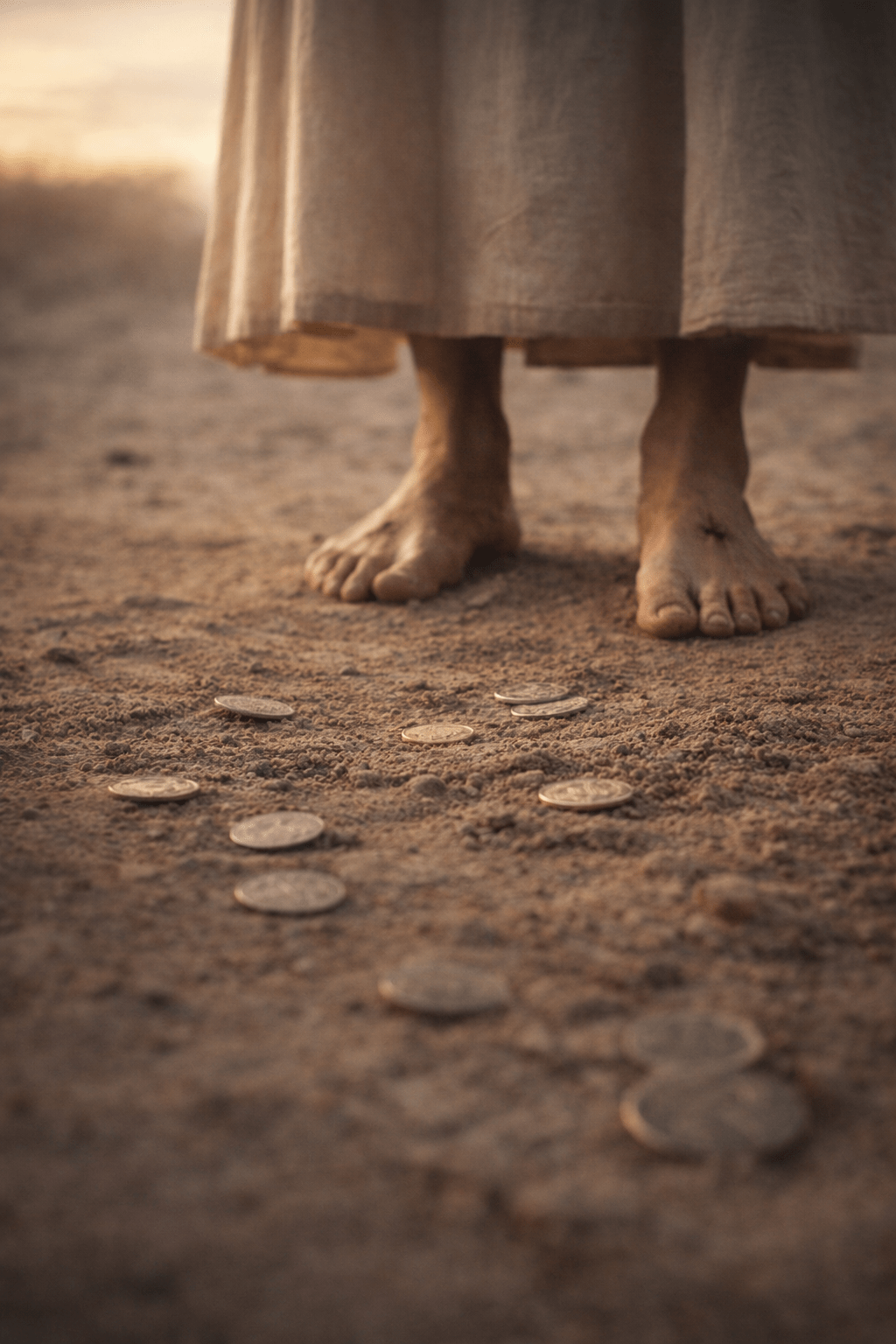
Two feet.
Close enough that the hem of a garment brushed the edge of his vision.
Scarred.
Marked.
Holes that did not bleed.
The earth beneath them did not recoil.
The scars were not grotesque.
They were kept.
Alive.
His throat closed.
All his arguments, all his rehearsed confessions, all his defenses dissolved into something far simpler.
He did not stand.
He did not reach.
He did not lift his eyes.
He only saw the feet.
And with longing and terror braided together, with childlike awe breaking through the ruins of a man who had misjudged the size of mercy—
Judas whispered,
“Rabbi.”

 Inkblots & Teapots