A faith introspection – The Resurrection
©ESR 2026
Before the desert, there had been walls.
Stone walls, sun-bleached and close, where voices carried too easily and women learned to make themselves smaller than their own questions. She had lived there once — in a village that clung to the edge of cultivated earth like a nervous child to a mother’s robe. She had drawn water from a shared well. She had ground grain. She had listened.
There had been teachers who spoke of a Deliverer. Of a Son. Of a kingdom that would break open the sky.
She believed them.
But belief did not quiet the ache in her bones. It did not still the sense that something was unfinished… not in the scrolls, not in the law, not in her own heart. She began to pray in the spaces between chores. At first for small things. Then for larger ones. Then for nothing at all except nearness.
The desert answered more honestly than the village ever had.
So she left.
No dramatic farewell. No argument. She simply walked east at dawn one morning with a waterskin and a bundle of bread and did not turn back. The sand took her footprints without complaint. The wind did not try to persuade her otherwise.
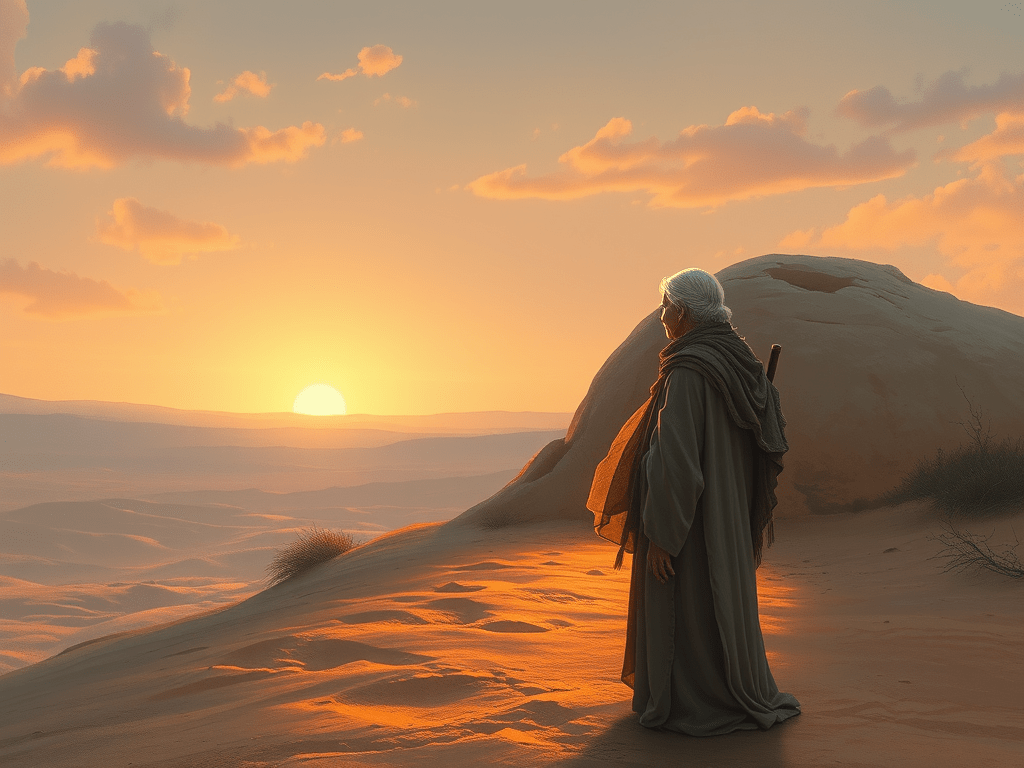
She built her dwelling from rock and patience. A small anchorhold pressed into the side of a low cliff, its entrance facing the horizon. She kept little. A mat. A jar. A scroll worn thin from repetition. The Psalms memorized long before she could read them.
She did not go to Jerusalem for feasts. She did not hear the itinerant teachers. She did not see miracles. When rumors reached her of a rabbi speaking in parables and eating with sinners, she heard them as one hears distant thunder — interesting, but not immediate.
Her Messiah, if he came, would not require spectacle.
She had chosen watchfulness instead.
Years passed. Her hair silvered. The skin at her hands thickened and cracked like the earth itself. She prayed at dawn. She prayed at noon. She prayed as the stars opened their thousand silent eyes.
“Come,” she would whisper into the wind. “Come as you will. I will be here.”
She did not imagine she would live to see it.
______
The morning the air changed, it did not announce itself.
There was no thunder.
No tearing of sky.
But the desert held its breath.
She woke before dawn as always, the cold still clinging to the stone floor. She stepped outside her dwelling, expecting the usual slow bloom of light along the horizon. Instead, the horizon seemed… closer.
The wind, which usually moved like a restless animal, lay still.
The birds did not cry.
Even the insects were silent.
She felt it first in her chest… a loosening. Not relief. Not fear. A shift.
She pressed her palm to the earth.
The ground felt warm.
Not with heat from the sun, the sun had not yet risen, but with something like release.
She did not know the word resurrection. Not as it would one day be spoken. She knew only the promises written in the prophets: that death would not have the final say, that the Holy One would not abandon His anointed to decay.
But such things were poetry.
This felt like fact.
She stood slowly.
And then she saw Him.
He did not approach from the horizon. He was simply there, as if the desert had shaped itself around Him and then remembered what it was meant to hold.
He bore no crown.
No visible blaze.
Only presence.
Wounds like quiet punctuation in His hands.
She knew.
Not because she had seen His face before.
Not because she had followed Him in Galilee.
But because the waiting inside her stopped.
He spoke only once.
“Peace upon you.”
The words were not thunderous. They did not echo. They did not command.
They settled.
Like oil poured gently.
Her knees gave way before her mind caught up. She fell into the sand, not from fear, but from recognition so complete it undid her. Tears came before speech. Not the tight tears of grief she had known in youth, but a flood that seemed to come from somewhere older than her body.
“You have come,” she said, her forehead pressed to the earth. “You have come.”
He did not answer.
The silence was not empty.
She lifted her face to look at Him fully. The sun was rising now, catching at the edges of His form, but not overpowering it. The wounds in His hands were not grotesque. They were… kept.
She wept harder.
“I was not there,” she said. “I did not go to the city. I did not stand at the cross. I did not cry out.”
The wind stirred slightly.
“I only waited.”
He did not rebuke her. He did not affirm her. He remained.
She felt then what had happened, not as report, but as reality. Death had been entered. And undone. Not erased… undone.
The finality she had braced herself against for decades had cracked.
“What does this mean?” she asked, lifting trembling hands toward Him. “If death has been broken… what is left to fear? What becomes of us now?”
Her voice did not accuse. It sought.
“The scrolls tell us You will come again to judge the living and the dead. But You have risen. The grave has yielded. Is the end here? Or is it only beginning?”
The desert did not answer for Him.
He watched her.
Listened.
The kind of listening that dignifies the question.
She felt foolish for a moment… a hermit woman in cracked sandals asking eternity for its itinerary.
But then she realized: this was not about chronology.
It was about participation.
The warmth in the earth spread into her bones. Not youth restored. Not body made new. But purpose clarified.
The resurrection was not a finish line.
It was permission.
Permission to live as if death had already lost.
She lowered her hands slowly.
“You do not need to tell me,” she whispered. “I will remain. I will keep watch still. Only now… I will keep watch for joy.”
The sun had risen fully.
She blinked once against the light.
And He was no longer there.
Not vanished dramatically.
Simply not visible.
The desert resumed its sounds. A bird called. The wind shifted. An insect hummed to life.
But nothing was the same.
She did not run to a city to announce it. She did not seek disciples.
She returned to her stone dwelling and knelt where she had knelt for years.
Only now her prayer changed.
Not “Come.”
But “Thank You.”
She would die in that desert many years later.
But she no longer feared the silence of the grave.
Because once, at dawn, peace had stood before her in the sand.
And she had known that death was no longer sovereign.

 Inkblots & Teapots